


The intro video explains some background of the bridge project and how it relates to the real world.
We use fun demonstrations to teach about different topics at play in bridges such as Force, Stress, & more!
Tune into the how to video to find tips, examples, and even obstacles to avoid when designing and building your bridge.
In this video, we walk you through just how to go about testing your bridge when you are all finished building!
Tyler Bell from CVL Engineering shares his story about why he wanted to become a civil engineer and what he does now!
Below are some of the more popular standard sets we find ourselves talking about with partners! If you don't see one that is important to you, please Contact Us and we can share our internal list with alignment to dozens more sets!
K-PS2-1: Motion and Stability: Forces and Interactions
Standard Name: Pushes and Pulls.
Description: Plan and conduct an investigation to compare the effects of different strengths or different directions of pushes and pulls on the motion of an object.
Project Context: Students observe how the "push" of the wind (from a fan or hair dryer) causes the turbine blades to move.
K-2-ETS1-1: Engineering Design
Standard Name: Asking Questions and Defining Problems.
Description: Ask questions, make observations, and gather information about a situation people want to change to define a simple problem that can be solved through the development of a new or improved object or tool.
Project Context: Students identify the problem (needing to lift a bucket of weights) and brainstorm solutions within the STIIX-Ville scenario.
K-2-ETS1-2: Engineering Design
Standard Name: Developing Possible Solutions.
Description: Develop a simple sketch, drawing, or physical model to illustrate how the shape of an object helps it function as needed to solve a given problem.
Project Context: Students create design ideas on paper and use materials like cardboard and skewers to build their turbine model.
K-2-ETS1-3: Engineering Design
Standard Name: Optimizing the Design Solution.
Description: Analyze data from tests of two objects designed to solve the same problem to compare the strengths and weaknesses of how each performs.
Project Context: Teams test their turbines, observe if they can lift the weight, and compare their blade shapes/angles with other groups.
4-PS3-4: Energy
Standard Name: Energy Transfer and Conversion.
Description: Apply scientific ideas to design, test, and refine a device that converts energy from one form to another. (In this project, students convert wind energy into mechanical energy to lift weights ).
4-ESS3-1: Earth and Human Activity
Standard Name: Natural Resources.
Description: Obtain and combine information to describe that energy and fuels are derived from natural resources and their uses affect the environment. (Directly relates to the lesson's focus on renewable/green energy ).
3-5-ETS1-1: Engineering Design
Standard Name: Defining and Delimiting Engineering Problems.
Description: Define a simple design problem reflecting a need or a want that includes specified criteria for success and constraints on materials, time, or cost.+
3-5-ETS1-3: Engineering Design Standard Name: Developing Possible Solutions.
Description: Plan and carry out fair tests in which variables are controlled and failure points are considered to identify aspects of a model or prototype that can be improved.
MS-PS3-5: EnergyStandard Name: Energy Transfer.
Description: Construct, use, and present arguments to support the claim that when the kinetic energy of an object changes, energy is transferred to or from the object. (The wind's kinetic energy is transferred to the turbine blades ).
MS-ESS3-3: Earth and Human Activity
Standard Name: Human Impacts on Earth Systems.
Description: Apply scientific principles to design a method for monitoring and minimizing a human impact on the environment. (Focuses on utilizing wind as a sustainable alternative to fossil fuels ).
MS-ETS1-4: Engineering Design
Standard Name: Developing Possible Solutions.
Description: Develop a model to generate data for iterative testing and modification of a proposed object, tool, or process such that an optimal design can be achieved.
HS-PS3-3: EnergyStandard Name: Design and Refinement of Energy Conversion Devices.
Description: Design, build, and refine a device that works within given constraints to convert one form of energy into another form of energy. (Core objective of building and optimizing a functional turbine ).
HS-ESS3-2: Earth and Human Activity
Standard Name: Management of Natural Resources.
Description: Evaluate competing design solutions for developing, managing, and utilizing energy and mineral resources based on cost-benefit ratios. (Aligns with the STIIX-Ville scenario where students act as energy engineers determining feasibility ).
HS-ETS1-2: Engineering DesignStandard Name: Designing Solutions for Complex Problems.
Description: Design a solution to a complex real-world problem by breaking it down into smaller, more manageable problems that can be solved through engineering.

The STIIX Wind Turbine project aligns with NSTA’s mission by fostering Three-Dimensional Learning, which combines Science and Engineering Practices (SEP), Disciplinary Core Ideas (DCI), and Crosscutting Concepts (CCC).
1. Science and Engineering Practices (SEP)NSTA emphasizes these eight practices as "Inquiry 2.0," moving beyond rote memorization to active sense-making.
Asking Questions and Defining Problems: Students must define how to lift a bucket of weights within material constraints.
Developing and Using Models: Students build physical replicas of turbines to represent their engineering ideas.
Planning and Carrying Out Investigations: Teams test different variables, such as blade shape and quantity, to see which optimizes power.
Constructing Explanations and Designing Solutions: Students iteratively refine their turbines to solve the energy needs of the fictional STIIX-Ville.
2. Disciplinary Core Ideas (DCI)The project directly addresses the physical and earth science concepts NSTA identifies as essential for "energy literacy".
PS3.A: Definitions of Energy: Understanding that moving wind has kinetic energy that can be converted to do work.
PS3.B: Conservation of Energy and Energy Transfer: Tracing how wind energy becomes mechanical energy to lift the weights.
ESS3.A: Natural Resources: Exploring wind as a renewable resource that impacts human sustainability.
ETS1.A: Defining and Delimiting Engineering Problems: Using specific criteria (lifting weight) and constraints (available kit materials) to guide the design.
3. Crosscutting Concepts (CCC)NSTA promotes these concepts to help students bridge different science disciplines.
Energy and Matter: Tracking the flow and conversion of energy through the turbine system.
Cause and Effect: Identifying how specific changes (e.g., angling the blades) cause a direct change in performance.
Influence of Engineering, Technology, and Science on Society: Using the STIIX-Ville scenario to evaluate how wind technology meets community needs.
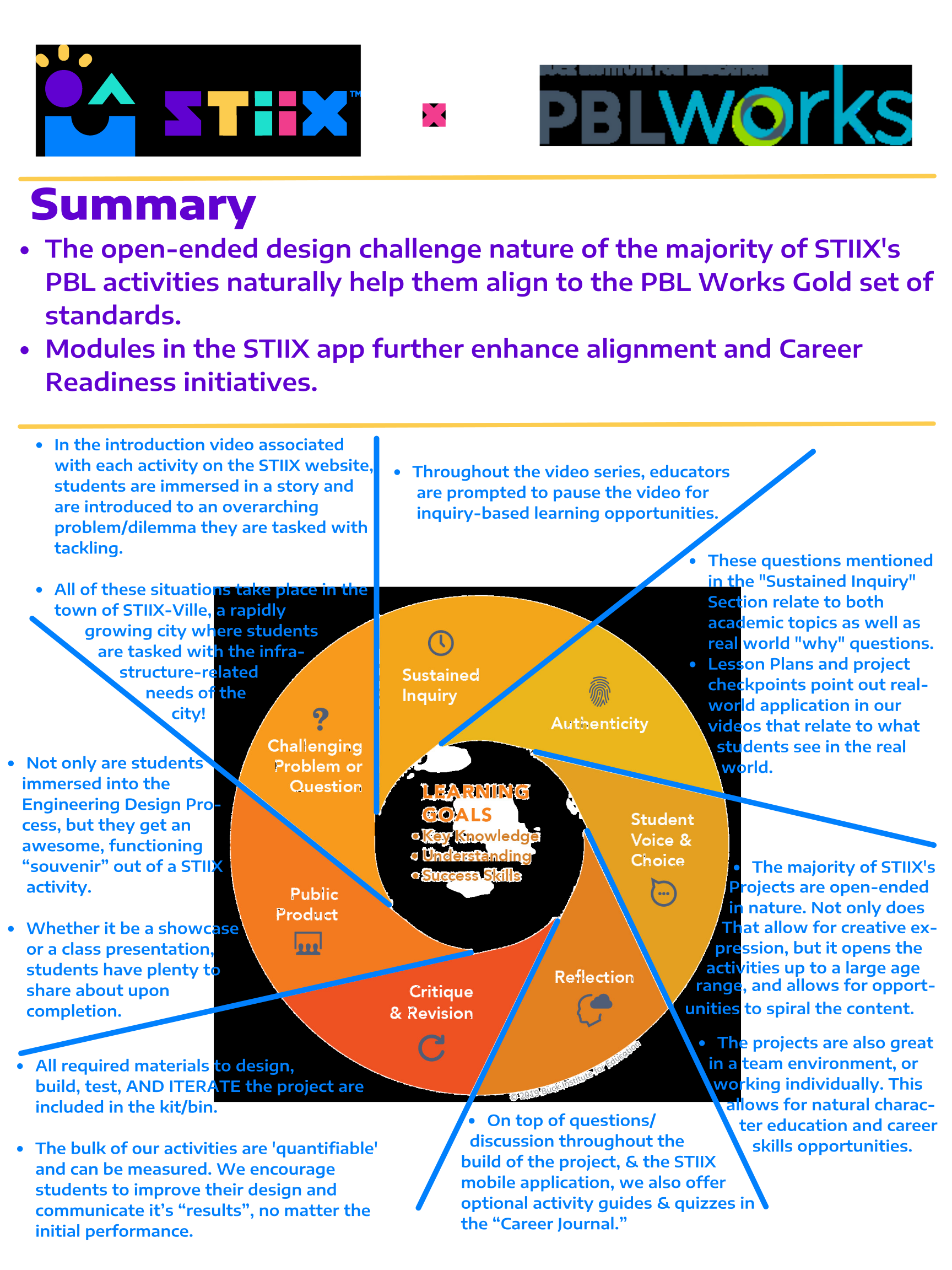
Check out the graphic below to see how the open-ended, project-based-learning nature, of our resources fit in with Gold Standard PBL.
1. Science, Technology, Engineering & Mathematics (STEM) Cluster
This is the primary cluster for this project, as students follow the Engineering Design Process (EDP) to solve a community energy problem.
Pathway: Engineering and TechnologyCareer Alignment: Design Engineer.Standard Alignment: Students use mathematical and scientific principles to design, build, and test a functional turbine prototype.
Activity: Iteratively adjusting blade size, shape, and quantity to optimize energy output.
2. Energy ClusterSince wind energy is a cornerstone of the renewable sector, this project directly simulates roles in power generation
.Pathway: Energy and PowerCareer Alignment: Wind Turbine Technician.
Standard Alignment: Understanding the Power Grid and how energy is converted from mechanical to electrical forms.
Activity: Analyzing the feasibility of wind-based power for a fictional community (STIIX-Ville).
3. Agriculture, Food & Natural Resources ClusterThe project addresses the environmental impact of energy choices and the management of natural resources.
Pathway: Environmental Service Systems
Career Alignment: Environmental Consultant.
Standard Alignment: Evaluating "Green" energy solutions to minimize ecological footprints.Activity: Using the AR app to explore how wind turbines interact with the local environment.
4. Manufacturing Cluster The construction phase of the turbine requires students to understand materials and assembly.
Pathway: Maintenance, Installation & Repair
Career Alignment: Field Service Technician.
Standard Alignment: Using tools safely and responsibly to build a mechanical system.
Activity: Following a 12-step technical guide to assemble the base, hub, and blade configuration.
Soft Skills Alignment (Social-Emotional Learning)The Framework also emphasizes "Employability Skills," which the lesson plan covers through its focus on Relationship Skills and Self-Management:
Collaboration: Working in teams of 1-3 to brainstorm and combine design ideas.+1Resilience: Handling the "inevitable obstacles and victories" during the iterative testing phase.
Mathematics Alignment
The project utilizes Standards for Mathematical Practice (MP), specifically MP.2 (Reason abstractly and quantitatively) and MP.4 (Model with mathematics), as students translate physical turbine performance into data points.
Elementary (Grades 3–5)
CCSS.MATH.CONTENT.5.MD.A.1: Convert among different-sized standard measurement units within a given measurement system to solve real-world problems.
CCSS.MATH.CONTENT.3.OA: Use operations and algebraic thinking to represent and solve problems involving the number of materials used.
Middle School (Grades 6-8)
CCSS.MATH.CONTENT.6.RP.A.1: Understand the concept of a ratio and use ratio language to describe relationships, such as the ratio of wind speed to power output.
CCSS.MATH.CONTENT.6.G.A.1: Find the area of triangles and polygons, applied here to calculating the surface area of turbine blades.
CCSS.MATH.CONTENT.6.SP.B.4: Display numerical data in plots, such as histograms or box plots, to analyze the results of multiple turbine tests.
High School (Grades 9–12)
CCSS.MATH.PRACTICE.MP5: Use appropriate tools strategically, such as using a multimeter to measure voltage and current or software to model designs.
High School Geometry/Algebra: Apply geometric concepts to solve design problems, such as optimizing the pitch angle of blades using trigonometric ratios.
English Language Arts (ELA) & Literacy AlignmentThe project supports literacy in technical subjects by requiring students to synthesize information from instructional videos and written guides to build a functional prototype.
Reading Informational Text (Grades 3–5)
CCSS.ELA-LITERACY.RI.5.1: Quote accurately from a text when explaining how the turbine converts energy or drawing inferences from design performance.
CCSS.ELA-LITERACY.W.5.7: Conduct short research projects using several sources to build knowledge through investigation of renewable energy topics.
Literacy in Science & Technical Subjects (Grades 6–8)
CCSS.ELA-LITERACY.RST.6-8.1: Cite specific textual evidence to support analysis of science and technical texts.
CCSS.ELA-LITERACY.RST.6-8.3: Follow precisely a multistep procedure when carrying out experiments, taking measurements, or performing technical tasks.
CCSS.ELA-LITERACY.RST.6-8.7: Integrate quantitative or technical information expressed in words with a version of that information expressed visually, such as in a flowchart or model.
Writing & Communication (Grades 9–12)
CCSS.ELA-LITERACY.RST.11-12.8: Evaluate the hypotheses, data, analysis, and conclusions in a science or technical text, verifying data from turbine tests.
K.1(A) & 1.1(A):
Scientific and Engineering Practices. Ask questions and define problems based on observations or information from models.
K.1(B) & 2.1(B): Scientific and Engineering Practices.
Use engineering practices to design solutions to problems.
K.7(C): Force, Motion, and Energy. Observe and describe the ways that objects can move, such as in a straight line or spinning.
1.11(A): Earth and Space. Distinguish between natural and manmade resources.
3.11(A): Earth and Space. Explore and explain how humans use natural resources such as in transportation and to make products.
4.11(A): Earth and Space. Identify and explain the advantages and disadvantages of using Earth's renewable and nonrenewable natural resources, such as wind.
5.1(G): Scientific and Engineering Practices. Develop and use models to represent phenomena or design a prototype for a solution to a problem.
5.8(A): Force, Motion, and Energy. Design a simple experimental investigation to test the effect of force on an object.
5.10(C): Earth and Space. Identify alternative energy resources such as wind, solar, and hydroelectric energy.
6.8(A): Force, Motion, and Energy. Investigate the relationship between force, mass, and acceleration.
6.11(B): Earth and Space. Describe the impact of research and technology on scientific thought and society regarding renewable energy.
MS-ETS1-1: Engineering Design. Define the criteria and constraints of a design problem with sufficient precision to ensure a successful solution.
7.11(A): Earth and Space. Analyze the impact of human activities on the environment, focusing on sustainable energy choices.
Physics 6(A): Force, Motion, and Energy. Investigate and calculate work, kinetic energy, and power.
Physics 6(D): Force, Motion, and Energy. Demonstrate and apply the laws of conservation of energy.
Environmental Systems 9(C): Global Policy. Evaluate the impact of wind power on the Texas economy and grid (Texas is currently a leader in wind energy at ~24% of the grid).
Integrated Physics and Chemistry (IPC) 6(G): Energy Transformations. Explore the conversion of energy between different forms, such as mechanical to electrical.